














Informal Value Transfer System (IVTS): How to Launder Money Without Transactions
- July 16, 2026
- 0
- 8 min read

Sponsored Content
A History of Hawala and ‘Flying Money’
Many centuries ago, early human traders moved goods back and forth between China and the Middle East along a network of pathways known as the silk routes. These are often mis-named in modern times as The Silk Road, since it was not a single highway, but a widely dispersed group of routes that brought interesting goods from afar into local markets, while relying on an informal value transfer system (IVTS) to remit payments across long distances.
Trade is the exchange of value through goods, services, or money. Since, at that time, all money was metallic coinage and value was often transferred via barter between merchants, one might wonder how these operations could work across long distances without refrigeration or automobiles. There was no paper currency, no wire transfers or credit cards, and certainly no crypto. Instead, they developed a system of trust without intermediaries that still survives today, facilitating both legitimate and illicit transactions in various forms. Broadly, such systems are known as informal value transfer systems: IVTS. The Arabic word for this is “hawala” which means “transfer”. The Chinese, on the other side of the ancient routes, called it “fei-chen” or “flying money”.
How IVTS Works
A person in one area, perhaps ancient Baghdad, wants to send money to someone elsewhere, perhaps a cousin who went to Central Asia to seek his fortune in Tashkent. This person would go to a local “hawaladar” who is part of a personal trust-based network of such money-movers. The person sending the money would then receive a code or symbol that must be sent to the relative in Tashkent. Upon receiving the symbol or coded message, the relative could then present it to the local Tashkent hawaladar and receive an equivalent amount of local currency. In principle, this leaves the Baghdadi hawaladar with money that is not his, and a Tashkenti hawaladar who has given money to a complete stranger. Operating with ledgers and established trust, these two people would then reconcile their debts by sending trade goods to compensate for the money that was distributed. For example, after several such transactions, the Baghdadi hawaladar could purchase a quantity of fine metal work or reams of paper and send them along the route to be received and sold by his correspondent in Tashkent. Along the way, both can take a percentage of funds in profit, and benefit from arbitrage by marking up exotic goods from elsewhere. In a world without banks or telegraph wires, this system was slow but effective, allowing caravans to travel and transfer money with less risk of theft, loss, or disaster.
Coming to America: The Black Market Peso Exchange
In the early 1980s the United States law enforcement agencies discovered a version of IVTS that allowed cartels to bring Colombian cocaine to the US and receive payment in kind quickly, without leaving much of a paper trail. This was known as the Black Market peso exchange (BMPE) and operated essentially along the same lines. BMPE is heavily associated with drug cartels, but the system is older than that. Before it was used to launder illicit proceeds, wealthy Columbians developed the system to evade strict governmental capital controls that inhibited investments and holdings abroad.
In this version of IVTS, a product is shipped from its origin, let’s say Colombia, to its destination, in the US. In the United States the product is sold for cash. The drug lords back home want their money quickly. So, the cartel associates in the United States sell their physical cash to a broker. That person, unconnected to the cartel itself, maintains a bank account in Columbia. With a simple transfer, that individual can pay the cartel boss inside Columbia, satisfying his need for quick compensation. Then, the cartel members go about their business and are out of the process. The broker himself now has unexplainable cash and an empty bank account in Columbia. To reconcile his own books he will purchase goods inside the United States, often acquiring cash discounts from wholesale merchants, and ship those goods to his home markets in Columbia. Upon reselling the goods, he can refill the bank account locally with pesos, and the merchant in the US is left now with the drug cash, two layers removed from its true source.
Blue Jean Laundering
Today, most of us know the Silk Road as a dark-web marketplace for illicit goods and services, and the cocaine cowboys of the 1980s seem to exist only in movies. Yet, the old ways are alive and well, as evidenced by the latest in several rounds of crackdown and scrutiny centered on the Los Angeles Garment or Fashion District. Ironically, one of this century’s best money laundering drug tales comes straight out of Movieland itself, the place where ‘the industry’ usually means film & television.
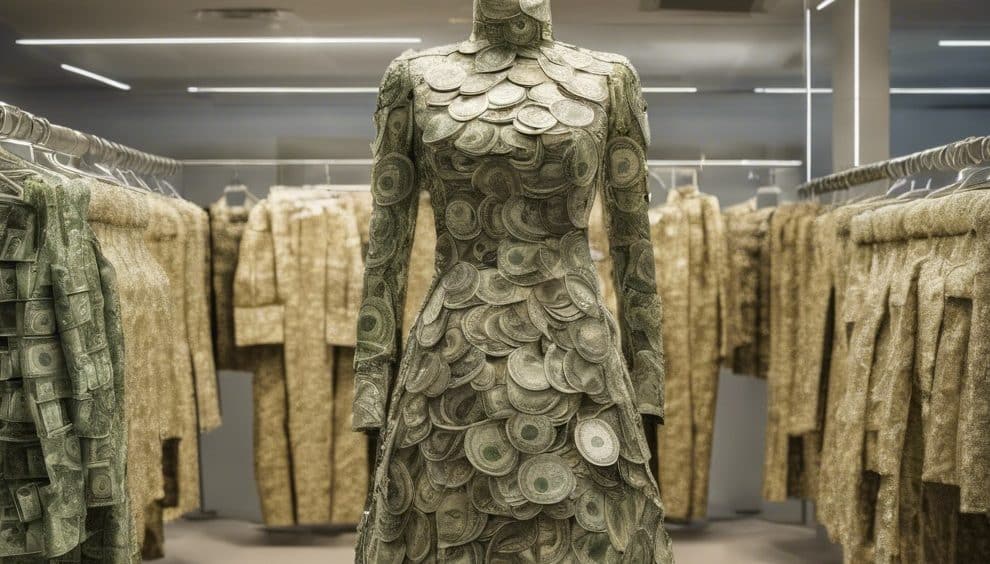
With its proximity to Mexico, cartels have long been drawn to high-volume, cash-based wholesale districts such as the garment district near downtown LA. Such marketplaces exist in cities around the country, and may be centered around other commodities: electronics, diamonds & jewelry, produce or grain. In some parts of the world, there are markets for petroleum, wildlife, and antiquities. Let your imagination run wild: if the task is to get cash back to your home country, any valuable goods that can be bought with cash and shipped abroad could be bought as a proxy for its cash value. In fact, many goods benefit from arbitrage, in which my 1980s brain automatically imagines bringing a pallet of US-made jeans to the former Soviet Union. A man could make a killing, they said. Today, used luxury cars go for triple in Brazil, and, in this case, the cartels went back to my old favorite: blue jeans.
Fit for A Hollywood Storyboard
The scheme is simple and classic, with plot twists to throw off the audience: a mid-level dealer in fine crystal methamphetamine finishes his daily rounds, collecting from street punks, with a large bag of dirty, crumpled cash. After counting and bundling it properly, he makes his way to the back of his favorite dive bar. A moped pulls up, the courier looks at the bag and uses a luggage-scale to test its weight. He makes several swipes on a mobile phone and offers the dealer a cigarette. They smoke in silence. The dealer receives a text-message and nods at the moped man, who putters off. At a safe house, the moped man drops off the cash and receives wages for the gig. He goes to the grocery store, and then home. Having confirmed by text that the moped-broker network has paid his boss abroad, the mid-level dealer goes about his business.
At the safe house, the broker has his cousin count the cash. It adds up, and gets combined with other cash. A driver takes the cousin downtown and waits in a parking lot while the cousin ducks into a narrow alley hung with fabrics and clothes of every type. The first merchant he approaches shakes his head and quickly heads to the back of the store, as does his friend, the second merchant. Across the street, a savvy man with tattoos and a cigarette waves the bag bearing cousin over to his stall. They do not exchange names. The bag of cash goes to the back of the stall, and a shipping order is created for two pallets of nice knock-off American Dream Jeans. The jeans, upon shipping to Mexico, fetch a 30% markup; this money refills the broker’s account, pays for his lifestyle, and pays for his network of conspirators.
Spot the Scheme: IVTS Indicators and Red Flags
Red flags in any kind of trade-based money laundering and IVTS schemes often look like the common list: unexplained cash, rapid transfers across borders, transactions outside the industry, anything unnecessarily complex. Where specific typologies emerge is often related to a single tidbit of information. Many FinCen alerts focus on activity that includes specific countries, regions, or customers with passports from a certain place. The ability to review shipping documentation, bills of lading, letter of credit information, or other detailed trade finance data is the only way to reveal price-manipulation or double-invoicing. A coordinated approach between trade finance, business due diligence, and AML departments will help separate legitimate operators from those moving illicit funds as part of IVTS schemes. Teams must cross-train so investigators learn about business & trade while customer-facing team members understand the vulnerabilities to exploitation via these types of schemes.