















Agentic Trust: When AI Agents Shop, How Do We Know It’s Legit
- May 26, 2026
- 0
- 5 min read

Sponsored Content
The concept of agentic trust arises in fraud detection when humans are no longer the only actors. In other words, how do you distinguish between good automation and bad automation?
Recently, I spoke with a friend and colleague who helped build an agentic AI fraud defense layer for a large gaming platform. The idea was ambitious: intelligent agents coordinating investigations, analyzing risk signals, and responding to fraud automatically at machine speed.
At first, the system worked remarkably well.
But in just 6 weeks the fraudsters deployed agents of their own.
Suddenly the platform’s defensive agents were facing offensive agents capable of probing the system continuously, adapting behavior, testing reactions, and optimizing attacks in real time.
That shift exposed something important.
The platform’s defense layer was excellent at orchestration. It connected systems, coordinated workflows, and accelerated investigations. But fraud is deeply domain-specific. It lives inside subtle identity patterns, behavioral relationships, ecosystem knowledge, and attack techniques that evolve constantly.
The attackers specialized around the platform faster than the generalized agentic layer could adapt.
That conversation stayed with me because it captures where online trust is heading. For years, fraud prevention focused on distinguishing humans from bots. A human was trusted while the bot was limited or banned. Today, the challenge revolves around distinguishing legitimate automation from malicious automation. It becomes a matter of agentic trust.
That same pattern is now moving into shopping. When an AI agent buys on behalf of a person, the merchant may see a clean session: a logged-in account, a normal payment method, a rational product choice, and no obvious automation artifacts. But the hard question changes. Did the user actually delegate this purchase, or did the system only observe behavior that looks consistent enough?
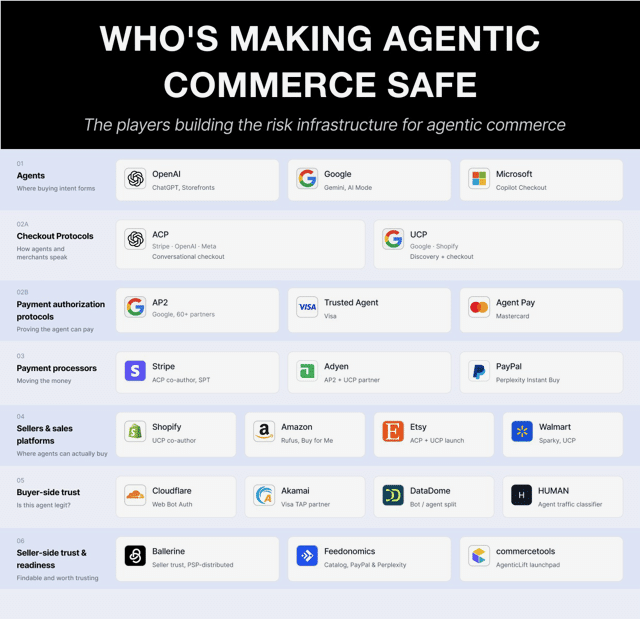
And that is a very different problem. According to Ballerine, an AI-native risk and compliance platform, today 73% of online merchants are not agent-ready, with many lacking the structured data, verification signals, operational clarity, and trust infrastructure that AI agents are likely to rely on when initiating or recommending transactions. Below is an image containing some of the companies working on solving the problem of enabling safe, or at least low-risk, agentic commerce.
What Is a ‘Trusted Agent’?
Traditional fraud systems relied heavily on behavioral authenticity. Mouse movements, typing patterns, navigation flows, and hesitation before checkout all helped identify suspicious activity.
Modern AI agents changed that equation completely.
Agents now browse naturally, maintain consistent sessions, and execute transactions with clean logical flows. Some offensive systems even simulate imperfect human behavior because optimized activity already attracts attention. The fraudsters’ agents learn how the defensive systems react and adapt around them continuously. So if behavior can be imitated, what are we actually measuring? What is a “good” agent?
The main question is how do we connect an agent to the human behind it:
- Does this behavior fit the long-term identity behind the account?
- Does the activity align with the broader relationship network surrounding the user?
- Does the interaction reflect authentic continuity or adaptive optimization?
Those answers require more than generic reasoning. They require specialized machine learning models and deep domain expertise.
When Everything Looks Correct, How Do We Detect Fraud?
In one regulated iGaming project I worked on, the lesson was similar. Fraud reduction didn’t come from one clever model. It came from combining account history, payment behavior, network signals, operational response loops, and people who understood the domain. The exact mechanics are not public, but the architectural pattern matters: orchestration helps only when the underlying signals are specific enough.
I believe it is a mistake treating the agentic layer as the fraud brain itself rather than as an orchestrator sitting above specialized intelligence systems.
In practice, different models should focus on separate questions. One system analyses what kind of attack pattern is currently unfolding on the platform. Another continuously validates whether the behavior still aligns with the legitimate account owner. Others look for hidden connections to previously identified fraud rings and coordinated abuse networks.
The agentic layer would then connect those signals together, coordinate responses, and adapt investigations in real time.
That architecture matters because modern fraud often looks perfectly legitimate in isolation. The real signals only emerge when multiple systems analyze the same event from completely different perspectives simultaneously.
Trust Will Become the Core Product
Fraud mitigation companies may eventually need trust layers designed specifically to establish agentic trust for agent-to-agent commerce. The platforms that can continuously validate delegation, intent, and behavioral continuity will likely define the next era of digital trust.
That may require systems capable of answering questions traditional fraud models were never designed for: Was this action truly authorized by a legitimate human? Is the agent still acting within the user’s expected boundaries? Does the behavior reflect genuine continuity or adaptive manipulation?
In that environment, the trust in “trust & safety” may become less about detecting isolated suspicious events and more about continuously validating relationships between users, agents, devices, and ecosystems over time.
With agentic trust, it’s a brave, new world we’re about to enter.