












Insurance Fraud: It Starts With the Lack of an Identity Check
- July 22, 2026
- 0
- 6 min read

Sponsored Content
Most people see insurance fraud as a time-of-claim problem not an identity check issue. A collision staged by bad actors, lost contents claim padded by non-existent belongings, a suspicious birth certificate, or a truckload of cargo that got lost after leaving the warehouse.
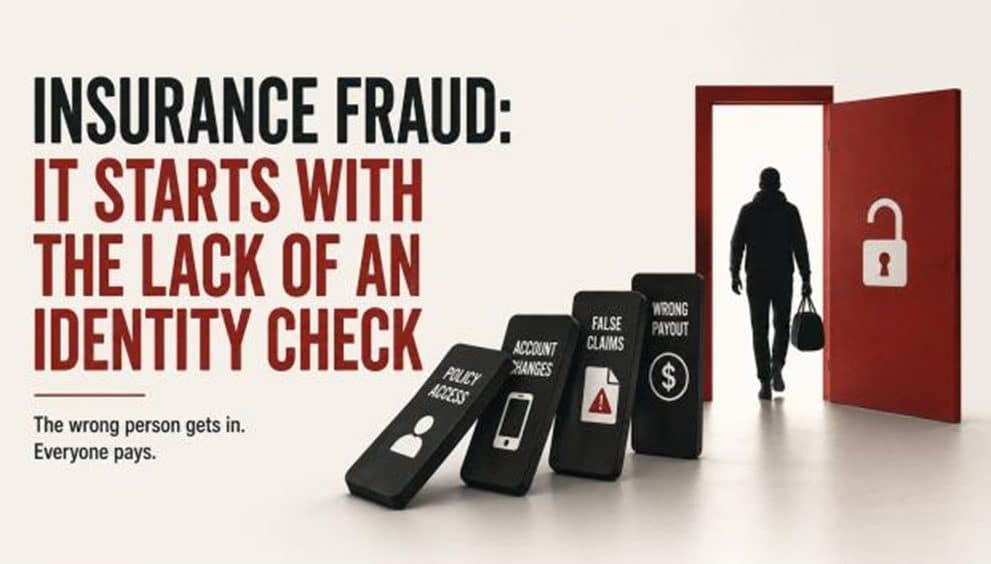
Much of that fraud actually starts before a claim is filed — when the carrier onboards a bad actor as a policyholder, granting access to someone who shouldn’t have it, or routing payments to accounts that don’t belong to the insured. The real question fraud teams should ask: which schemes fall apart when identity assurance is continuous, not just a one-time check?
Not all of them, but enough fraud cases have nothing to do with identity. However, those built on impersonation, fake relationships, or hijacking someone else’s authority become much harder to maintain when you have to keep proving who you are.
Why The Insurance Identity Check Matters Now
The National Insurance Crime Bureau (NICB) projected identity-theft-related insurance crime could rise by about 49% by the end of 2025. Nearly one in four questionable claims referred to NICB for identity theft involved a synthetic identity, the kind of manufactured persona that can survive a superficial application check while having no legitimate connection to the insured risk. They highlighted life insurance account takeovers and fraudulent renters policies followed by face claims. These aren’t your typical dishonest claims. They work because the carrier trusted someone who had no real right to act, file, or get paid.
Fraudsters find the gaps between underwriting, servicing, claim, and payments. Identity assurance needs to follow the policyholder, the claimant, the beneficiary, and the payments.
Scheme #1: Life Insurance Account Takeover
A criminal gets into a real policyholder’s account with stolen credentials or social engineering. Account takeover is not a niche problem. Javelin Strategy & Research estimated that it accounted for roughly $16 billion of the more than $27 billion lost to identity fraud in the United States during 2024. Life insurers are increasingly exposed to that same criminal playbook, except the prize may be a cash-value policy, a surrender payment, or a future death benefit. Then they start changing contact info, beneficiaries, bank accounts, request loans or surrender the policy for its cash value, or redirect death benefits. If carriers only do strong identity checks at issuance, they’re protecting the part fraudsters care about the least.
The real risks come later: beneficiary changes, account recovery, loans, or benefit claims after a death. Logging in successfully doesn’t confirm it’s the real policyholder — the fraudster may have stolen enough of someone’s digital life to look like them. Continuous identity checks change that. High-value actions like changing a beneficiary or bank account need verification of identity, authority, device, and behavior — not to hassle routine users, but to catch sequences that don’t look right: a new device, a recent email change, a beneficiary update, and a payment redirection request all at once. A lot of fraud doesn’t start with a fake death claim. It starts quietly with a beneficiary change no one questioned.
Scheme #2: Fraudulent Renters Policies and Fictitious Claims
A fraudster buys a renters policy using a stolen, synthetic, or manipulated identity for a place they do not actually live. Months later, they file a claim for stolen or damaged belongings that never existed.
NICB specifically identified renter’s policies purchased for properties where the fraudster has no contract, followed by fictitious claims, as a prevalent identity-enabled scheme.
At application, a carrier may confirm that a name exists and a premium payment clears. But those are the easy questions. The harder ones are the ones that matter: Does this person actually live there? Does the claimant have a real connection to the address? Does the same device, bank account, phone number, or mailing address appear across other questionable policies or claims? And when money is ready to move, does the payment account actually belong to the insured?
A carrier can accurately confirm that a person exists and still insure a relationship that does not.
The Schemes That Don’t Collapse with an Identity Check
Identity assurance isn’t a fix for everything. A real homeowner can still pad a storm claim, a real driver can exaggerate injuries, people stage real accidents, and applicants can prove who they are and lie about health issues. Those still need traditional tools like underwriting, claims analysis, network checks, and SIU work.
But identity assurance hits hard where fraud relies on pretending to be someone else or claiming authority they don’t have. That’s a big chunk of the problem. It doesn’t replace other controls. Instead, it makes them stronger by answering the basic question: who exactly are we dealing with?
Following Identity Through the Transaction
Carriers don’t need to add friction everywhere. They need to spot the high-stakes moments like beneficiary applications, account recovery, beneficiary changes, claims, and payments to beneficiaries; so they can handle them appropriately.
One identity check is enough to issue a policy. It’s not enough to protect it for years. The Reinsurance Group of America (RGA) and the Medical Information Bureau’s (MIB) 2024 U.S. Life Insurance Fraud Survey found fewer than one-third of respondents were using algorithms or analytics to flag questionable underwriting applications — a front-door problem. The larger problem is what happens after issuance, when identity signals aren’t carried into account recovery, beneficiary changes, claim submission, and payment release.
When someone takes over a life insurance policy or claims losses from a place they’ve never even been, the real failure happened earlier in a chain of unchecked identity decisions.
Fraud prevention will always involve investigating crashes, fires, thefts, and deaths. But the fraud easiest to stop before payout is the kind that needs the wrong person trusted long enough to get paid. That starts to fall apart when the carriers ask at every key step: who are you, why are you allowed to do this, and why should you get the money?
It’s a question that should be asked much earlier.