











Inside Gray Zone Fraud, AKA ‘Its Not Fraud, Just Coding’
- August 20, 2026
- 0
- 5 min read

Sponsored Content
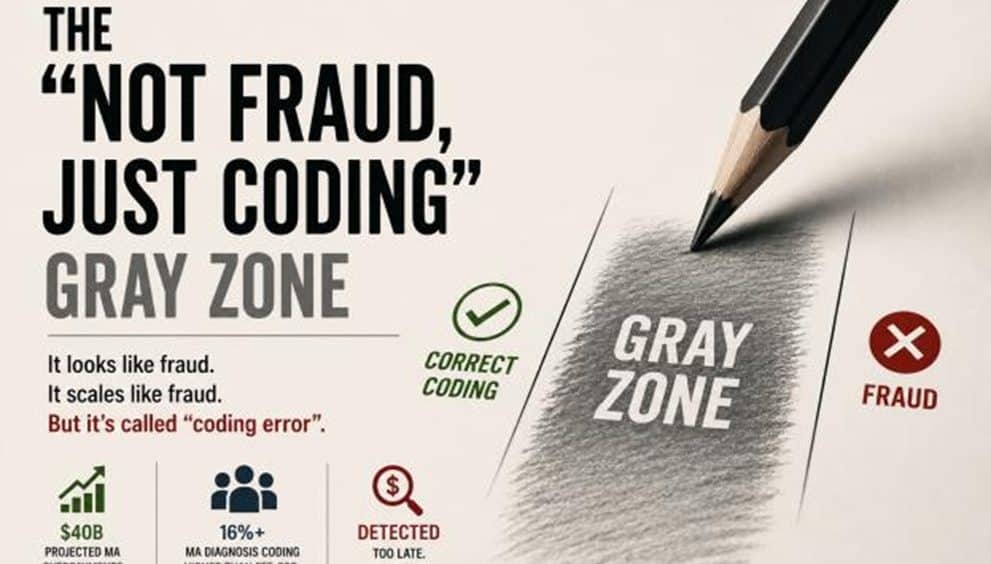
Gray zone fraud is one of the trickiest and most costly, and also most undetected healthcare fraud schemes in the industry. These unsavory billing practices are so gray that they are not always flagged as fraudulent. The Centers for Medicare and Medicaid Services (CMS), in fact, even after recognizing $28.8 billion in Medicare FFS improper payments suggested that it was just documentation/medical necessity errors.
If it’s not fraud, then why does it look, scale, and pay just like fraud does?
This gray zone fraud is much less obvious and much less publicized than the more blatant healthcare fraud schemes. More blatant and commonly recognized healthcare fraud accounted for $14.6 billion in charges in that famous, largest healthcare fraud takedown in US history. But the more ambiguous, and less easily classified gray zone coding accounts for around $40 billion of Medicare Advantage’s projected $84 billion of overpayments in 2025. Medicare Advantage plans get paid based on how sick their patients look on paper, and their diagnosis coding runs about 16% higher on average than fee-for-service coding for similar patients. At 16 Medicare Advantage organizations, that gap is more than 20%.
Anatomy of Gray Zone Fraud
Evaluation and management billing codes used for ordinary patient office visits are tiered based on the complexity of the patient diagnosis and treatment. In 2010, an Office of Inspector General (OIG) review found that almost 26% of basic evaluation and management claims were wrongfully upcoded, to the tune of about $6.7 billion a year. The challenge is that each individual upcoded visit does not necessarily look like fraud – the fraud is only identified by a pattern of upcoded visits.
Unbundling treatment codes is a classic way to maximize revenue from billing healthpayers for services rendered to their beneficiaries. Instead of bundling together services that are normally bundled together and paid at a group rate, providers and facilities will sometimes unbundle services provided since the billing of individual services usually exceeds the group cost of all treatments combined.
Providers can direct healthpayers to treat as two separate procedures that were performed on a single patient in a single day. Providers provide this billing instruction by providing with their claims a modifier to healthpayers, in this case the Modifier 59. Providers submit this modifier about 40% of the time; meaning providers are specifically instructing healthpayers that multiple treatment codes performed on the same day, the same patient visit, should be billed separately, 40% of the time.
Another gray zone treatment and billing scheme is when providers skirt the edge of feasibility by signing off on treatments that might only be considered borderline medically necessary. This judgement and action by a provider is easily defensible by a provider as healthpayers rely so much on providers’ treatment judgement inside the exam room.
Why Gray Zone Fraud Is Uncomfortable
Since all of these gray zone treatment codes and corresponding billings come from the same providers who are providing trusted critical healthcare to patients, these tactics go unseen and unchecked. These actions by legitimate providers who commit this gray zone fraud are often not detected because individual instances of overbilling do not show an obvious intent to perpetrate fraud. It’s only after a provider perpetrates this type of billing fraud does the intent actually become undeniable to investigators. Providers have also been known to rely on billing consultants and revenue-cycle software designed to optimize reimbursement rates and amounts.
What Healthpayers Can Do
There are three different tactics investigators suggest healthpayers do to check gray zone fraud.
The first and probably the easiest to perform behavioral analytics on coding patterns to identify drift. Drift is when a provider normally bills level 3 visits 60% of the time, and suddenly bills level 4 visits 60% of the time, when there is no change to the mix or demographic of their patients.
Another meaningful tactic is peer-group outlier detection analytics. A peer is considered another provider who practices the same speciality of medicine and in a similar geography. When you compare 20 cardiologists in the same city with respect to their use of modifier 59, and most are using the modifier only 10% of the time but a few of them are using modifier 59 40% of the time, those few providers are probably up-billing health payers fraudulently.
In today’s healthcare fraud mitigation environment, most healthcare fraud is still being detected after the claim has been paid – “pay and chase”. Like other types of healthcare fraud, the real fraud mitigation should happen before the claim is paid. In the case of high-drift billing by providers, healthpayers should move the review of those providers’ gray zone payments into their pre-payment review function.
A Practitioner’s Closing Thought
To date, gray zone fraud billing has accounted for more losses to healthpayers than every criminal takedown combined. Yet most in the business do not even call it fraud. So maybe the fraud question is really: are we measuring fraud, or are we just measuring what we are comfortable adjudicating?