


















Managing AI Employees: Lessons for Fraud Leaders
- June 21, 2026
- 0
- 7 min read

Sponsored Content
In an era where payments fraud rings move faster than traditional detection systems can adapt, scaling analytical capabilities with AI is quickly becoming a baseline requirement for survival. Across fintech, e-commerce, and banking, leaders are experimenting with AI agents that can accelerate investigations, analyze data, and even help build fraud detection models. These AI employees can dramatically increase organizational efficiency and the productivity of humans that use them.
But as organizations move from experimentation to production, they face an important question:
Q: If one AI tool can do everything, why are leading teams increasingly choosing to use several?
The answer has less to do with technology and more to do with organizational design.
The path you choose determines whether your digital workforce scales smoothly, or collapses under the weight of rising costs, poor decisions, and operational complexity.
The idea of breaking down analytical workflows into specialized AI roles came to me after attending an excellent lecture by my colleague and senior data scientist, Inbal Fleischer. In her presentation, “From Programming to Managing Your Own Team,” Inbal highlighted a massive mental shift happening.
As she put it: “When trying to build a complex project from scratch with a single autonomous agent, it tends to get stuck, enter infinite loops, and fail to deliver. The solution requires a mental shift from the role of a Programmer to that of a Team Leader who manages a specialized squad of AI agents.”
That observation raises an interesting question:
Q: As AI agents become more capable, should organizations think of them as tools, or as AI employees?
The answer may be both. And if we think of them as AI employees, many of the lessons we’ve learned from managing human teams suddenly become relevant again.
Broadly speaking, organizations tend to organize their AI operations in one of two ways: the Monolithic Approach or the Micro-Team Approach.
The Monolithic Approach: The Overloaded All-Purpose AI Employee
Imagine hiring a single employee and asking them to investigate fraud, analyze data, write software, validate compliance requirements, test their own work, and present results to leadership.
Even the most talented professional would eventually become a bottleneck.
Many organizations unknowingly build AI systems the same way.
In the monolithic approach, a single AI tool is expected to handle every stage of an analytical workflow. It receives access to data sources, business objectives, technical requirements, and operational constraints, all within the same conversation. The expectation is that one system can understand the problem, gather information, write code, validate outputs, and produce the final result.
Initially, this feels efficient. There is only one interface, one conversation, and one decision-maker.
But problems emerge as complexity grows.
Just like people become less effective when too much information is thrown at them at once, AI systems can also lose focus when asked to juggle too many responsibilities simultaneously. Transaction logs, database metadata, code outputs, business rules, compliance requirements, and error messages all compete for attention.
Eventually, information overload begins to affect decision quality.
The result is often familiar to anyone who has managed a team: overlooked details, flawed assumptions, inconsistent reasoning, and costly mistakes.
The Micro-Team Approach: Building a Department of AI Employees
Successful organizations learned long ago that specialization improves performance.
Rather than relying on one overworked expert, companies divide responsibilities across analysts, engineers, investigators, quality reviewers, managers, and auditors. Each person focuses on a specific task while contributing to a larger goal.
The same principle increasingly applies to AI.
Instead of relying on a single overloaded agent, the micro-team model breaks a complex workflow into a tightly coordinated group of specialized digital workers. Modern environments such as GitHub Copilot’s Sub-Agents or Claude’s Teammates allow organizations to create AI teams where each agent operates in its own dedicated workspace with clearly defined responsibilities.
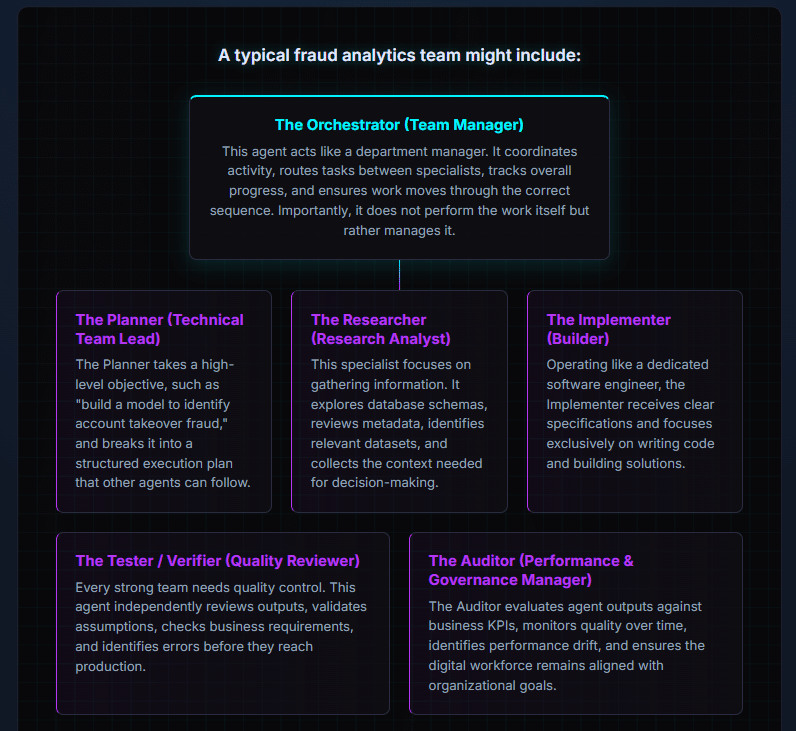
The Orchestrator (Team Manager)
This agent acts like a department manager for AI employees. It coordinates activity, routes tasks between specialists, tracks overall progress, and ensures work moves through the correct sequence. Importantly, it does not perform the work itself but rather manages it.
The Planner (Technical Team Lead)
The Planner takes a high-level objective, such as “build a model to identify account takeover fraud,” and breaks it into a structured execution plan that other agents can follow.
The Researcher (Research Analyst)
This AI employee specialist focuses on gathering information. It explores database schemas, reviews metadata, identifies relevant datasets, and collects the context needed for decision-making.
The Implementer (Builder)
Operating like a dedicated software engineer, the Implementer receives clear specifications and focuses exclusively on writing code and building solutions.
The Tester / Verifier (Quality Reviewer)
Every strong team needs quality control. This agent independently reviews outputs, validates assumptions, checks business requirements, and identifies errors before they reach production.
The Auditor (Performance & Governance Manager)
As my colleague Aviv Ben Arie, Founder and AI Strategy Consultant at Primavera, recently pointed out, building a team is only half the challenge. Someone must continuously measure whether that team is actually performing. The Auditor evaluates AI employee outputs against business KPIs, monitors quality over time, identifies performance drift, and ensures the digital workforce remains aligned with organizational goals.
Just as human organizations separate development, testing, management, and auditing responsibilities, digital teams benefit from similar boundaries. Each AI employee specialist operates independently and communicates through the Orchestrator, reducing confusion, lowering operating costs, and improving reliability.
The Operational Trade-Offs
Choosing between these approaches requires balancing simplicity against scalability.
Monolithic systems are easy to understand, quick to deploy, and require minimal setup. For simple, sequential workflows, a single AI tool can often deliver excellent results.
However, real-world fraud operations rarely remain simple for long.
What happens when an unusual pattern emerges?
What happens when a compliance review must interrupt an investigation?
What happens when multiple workstreams need to run simultaneously?
These situations require coordination, specialization, and adaptability, areas where micro-teams tend to outperform monolithic systems.
The data reflects this reality. Research has shown that well-coordinated multi-agent systems can significantly outperform single-agent approaches on tasks that benefit from parallel execution and specialized reasoning. However, management still matters. Poorly organized AI teams can create their own inefficiencies, just as poorly managed human teams can.
Adding more agents does not automatically create better outcomes, just like adding more human employees does not always guarantee greater productivity.
The goal is not to build the largest possible AI employee workforce. It is to build the right one.
Navigating the Infrastructure Reality
As risk leaders evaluate how AI will transform their organizations, the temptation is often to chase increasingly autonomous systems made up of dozens of digital workers operating independently.
But complexity carries a cost.
More agents mean more coordination, more oversight, more opportunities for miscommunication, and ultimately more infrastructure spending.
The future may not belong to organizations that deploy the largest AI swarms. It may belong to those that build the most disciplined digital teams.
The most effective AI organizations will likely resemble the most effective human organizations: small groups of specialists operating within clear structures, clear responsibilities, and clear accountability.
The biggest mistake leaders can make is assuming that adding more AI automatically creates more productivity.
As Aviv Ben Arie notes, organizations should treat agent evaluation with the same rigor they apply to financial auditing. Without objective performance measurement, even the most sophisticated AI workforce risks becoming a black box.
Human organizations learned long ago that success depends not only on talent, but also on structure, accountability, performance measurement, and role clarity. As AI agents become part of everyday fraud operations, the same lesson applies.
In the coming years, the competitive advantage in fraud prevention may not belong to who has the smartest AI agent or best models, but to who has designed, and continuously measured, the most effective digital risk team.