












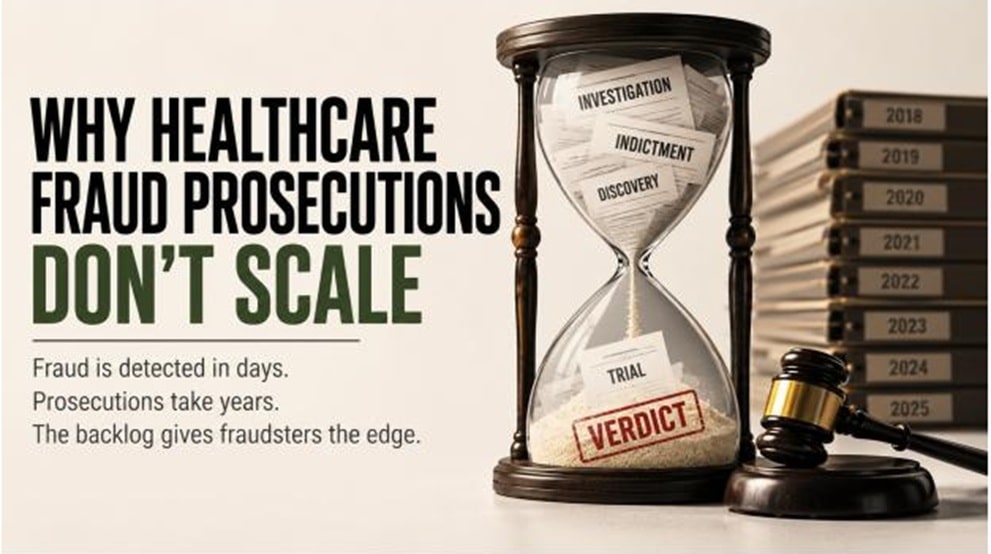
Why Healthcare Fraud Prosecutions Don’t Keep Up with the Crime
- November 5, 2026
- 0
- 5 min read

Sponsored Content
From September 2016 to May 2018, a nurse in Carthage, Tennessee named Heather Marks prescribed nearly a million opioid pills to less than 1,000 patients, according to the Justice Department. Eight years later, just this past spring, she was convicted in a healthcare fraud prosecution for this illicit activity.
Where I live in rural Virginia, if you commit a crime you are quickly arrested and standing before a magistrate, and pleading your case before a district court judge within a couple of months. The payoff equation for those who perpetrate health care fraud is much more favorable to the criminal, and the risk of punishment is comfortably delayed by the adjudication process.
The years I was not in financial services, I spent fighting health care fraud waste and abuse, at both a defense contractor and at a global systems integrator, building prepayment fraud analytic solutions and selling those solutions to Medicare, state Medicaid programs, and commercial health payers. I was a part of an industry-wide shift around 2010 from the pay-and-chase fraud mitigation model to the adoption of advanced fraud analytics and adverse fraud-risk prepay decisions on provider claims while the claim still sat on the payment floor. Our fraud analytics and decision management solutions enabled fraud to be detected and prevented in a day, while the providers whose claims bypassed those checks enjoyed years of delay in adjudication. The real bottleneck existed in the adjudication, not the fraud detection processes.
The Clock on Healthcare Fraud Prosecutions
No matter how big the case is, the steps for an indictment, discovery, and a trial do not move any faster. All of those steps will continue to happen during lawyer-hours. Olga Popovych had paid ambulette drivers cash for patient referrals to Brooklyn physical therapy clinics from 2018 to 2020. Medicare paid those clinics more than $8 million. Her trial lasted one week, but the conviction came more than six years after the scheme ended.
The investigators are stretched thin. The Justice Department already runs eight different regional healthcare fraud strike forces. In May, the department added 15 new prosecutors to investigate Medicaid fraud. Those 15 prosecutors are responsible for prosecuting what the Association of Certified Fraud Examiners (ACFE) calls a $480 billion a year fraud problem.
In 2023 the Health and Human Services (HHS) Inspector General had to report that they’d turned down 650 cases referred by Centers for Medicare and Medicaid Services (CMS) and forsaken 3,562 complaints from the various fraud hotlines, all because of a shortage of adequate staff to investigate the cases. The HHS IG office’s $432 million budget only represents about 2 cents per $100 in CMS claims reimbursements.
The Map on Healthcare Fraud Prosecutions
Healthcare fraud enforcement is disparate and all over the map with 94 disparate federal judicial districts, each with their own set of priorities and their own staff.
The investigative and prosecutorial work is not evenly spread across the country. As an example, back in 2024 the Southern District of Florida, one of the busier districts, sentenced 65 healthcare fraud cases, which was more than double New Jersey’s 31 cases. And according to the US Sentencing Commission, neither of Virginia’s two federal districts made it into the top five.
Even the laws can vary across states. For example, only 27 states and Washington DC have their own False Claims Act which incentivizes whistleblowers to sue on the government’s behalf for a share of the recovery. Enough states don’t have these laws, which allows for fraudsters to get away with fraud in some states than others where they wouldn’t otherwise.
It only makes sense that fraud rings select their turf intentionally.
The Sentence on Healthcare Fraud Prosecutions
Regardless of how aggressive, efficient, or effective the district, the penalties for the crime somehow always end up being lighter than they should be.
If you look at healthcare fraud sentences during 2024, the average sentence was about 27 months, according to Sentencing Commission data. Only about 18% of sentences fell inside the recommended guideline range, about 81.5% of them fell below the range, and fewer than 1% actually went above. And some defendants even skip sentence all together, as the HHS Inspector General’s fugitive list is 55 names long.
Even when fraudsters are sentenced, the sentences generally don’t yield expected restitution payments. According to the Government Accountability Office, of the $110 billion in outstanding federal crime restitution at the end of 2016, $100 billion of that was deemed uncollectable and multi-year collection efforts only yielded $2.95 billion.
For some fraudsters, like Brett Blackman with his company DMERx, sentencing is still profitable as the government is expected to collect about $450 million in restitution after over $1 billion in false billings mostly from spam mailers and kickbacks.
What Fraud Teams Should Do
Do what you think the fraudsters would least like you to do. If a fraudster has a scheme that relies on the slow processing of claims payment verification, then deploy prepayment holds. If a fraudster is relying on uninformed enforcement in a particular district, then step up the payer-to-payer data sharing. If a fraudster is relying on perpetrating fraud in a district with notoriously light sentences, then stand firm on exclusions and revocations.
Lean harder on the administrative tools in your toolbelt. CMS has had success against fraudsters by suspending 1,079 providers and revoking billing privileges for another 1,403. It was quicker to take those administrative actions against those bad providers than it was to wait for adjudication by a jury.
Make fraud deterrence the goal, not the big headlines.
Closing Thoughts
Healthcare fraud enforcement still pays for itself. The healthcare fraud and abuse control program returned two dollars and eighty cents for every dollar spent between 2021 and 2023. However, that’s down from eight dollars and ten cents a decade earlier.